


Author:
Kim Warchol, Founder of Dementia Care Specialists at CPI
Announcing My Retirement
I have been an occupational therapist (OT) since 1989. Some say they count down the days to retirement. Others have told me they screamed in joy, music blasting as they drove away on that last day. I find myself neither counting the days nor leaving in joy. I am simply present in this unique moment as I retired 3/31/26.
How do I feel about retirement? Bittersweet, I suppose. I’m really not quite sure what all the fuss is about as it feels like I’m just going on a long vacation. But in the quiet moments when the reality of my retirement seeps in, gratitude finds me. Gratitude for having a mission, not a job. Gratitude for connecting with so many others along this 35 year journey who are from “the same tribe.”
I am grateful beyond belief to have had this calling to become a dementia specialized OT. The stuff an OT is made from will always be me. My passion for our precious elders with dementia will never retire. As I stand on the threshold of this change I make the crossing with immense gratitude for what was, and curious excitement for what will be. I don’t suppose most who hold a mission deep in their heart ever feel their work is truly done.
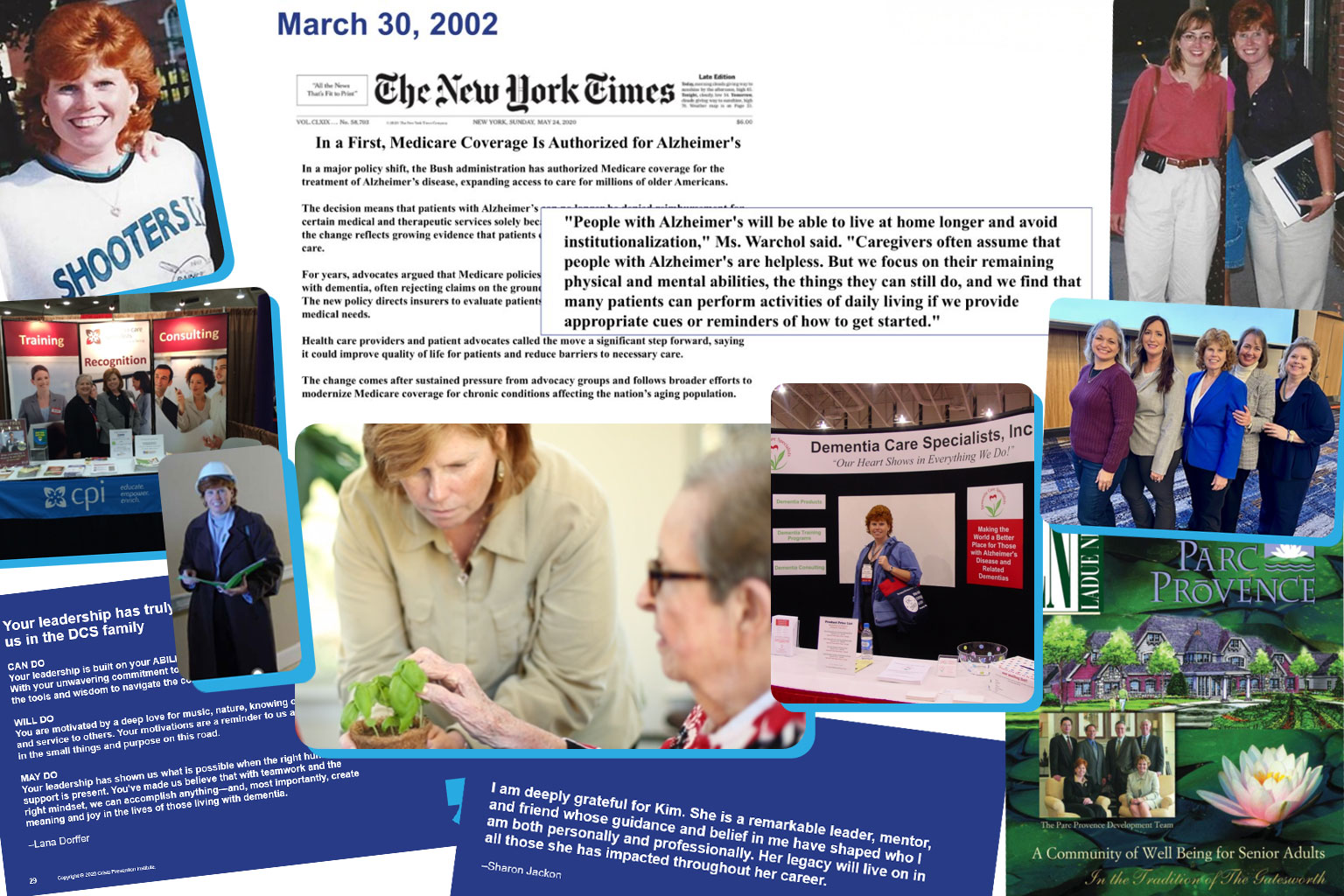
A Recollection of My Journey
Being introduced to Claudia Allen’s Cognitive Disabilities model so many years ago, in the mid-90’s, was a pivotal moment, and it changed the trajectory of my career and life. It opened my eyes to the potential for someone to live well with dementia, and I felt called to act. Learning the Allen model and getting to know Claudia, was the singular most influence on my career.
Claudia was brilliant, tenacious, and passionate and she cared deeply about those with cognitive limitations. Claudia bestowed her blessing as we evolved her model from mental health into dementia care. Having the opportunity to brainstorm with Claudia about the evolution of her model into dementia care was deeply rewarding.
After feeling called to serve elders living with dementia, and now infused with Allen’s approach, I decided to become a dementia specialized OT (a dementia therapist) and believed there was much someone with my knowledge could do to help. So, along with Kris Palazzi we formed Dementia Care Specialists (DCS) in 1999.
Through the years DCS has delivered many services including providing direct patient care as an OT Medicare Part B Private Practice serving those with dementia at home and in ALFs, providing dementia training and memory care consultation services and environmental design.
- Fighting a System That Said “No” - We challenged CMS’ determination that OT, SLP and PT services weren’t appropriate for those with dementia and we won.
Years ago we knew families often received the diagnosis from the physician, medication and a pamphlet, but not much more. How would they navigate the day-to-day realities of living with dementia, I wondered? How could suffering from dementia be avoided if they had someone to listen and guide them? I believed there was a gap to be filled and a dementia specialized OT had a role.
Around 2000, the DCS OT Med B Private Practice was receiving physician orders, primarily from Alzheimer’s diagnostic centers, to see people with dementia at home, after diagnosis. I created this DCS home care practice with the idea that “someone with a chronic, progressive dementia could be served by OT to optimize and maintain their level of function, safety, health and quality of life. And, in the process, the family would be educated and supported.” I asked these physicians to refer to DCS for these reasons, and they did. There was just one problem: Medicare wouldn’t pay for it.
The practice was flourishing with multiple referrals however Medicare wouldn’t pay, stating “not medically necessary”. Claim after claim was denied. I appealed. Denied. Appealed again. Denied again.
At one point, I received a letter from the Medicare intermediary stating, “There is nothing an OT could do to help those with dementia- not appropriate.
I knew that wasn’t true—because I was seeing the impact firsthand. So I kept pushing. I partnered with the Alzheimer’s Association and their advocacy lawyer Leslie Fried. Our documentation was submitted as evidence of meeting Medicare billing criteria, and Claudia Allen and I were interviewed. Family testimony was obtained sharing real stories from families whose lives were changing.
In September 2001, we finally saw a major breakthrough. I’m so happy to say that on September 25, 2001 CMS put out a Memorandum that said, “Contractors may not install edits that result in the automatic denial of services based solely on the ICD-9 codes for dementia.” This ruling created a lot of attention including a NY Times article published in March 2002 entitled, “In a First- Medicare Coverage is Authorized for Alzheimer’s.”
That moment didn’t just change my business—it changed access to occupational, physical and speech therapy across the country.
- The honor of a lifetime has been to be trusted by those living with dementia, and their loved ones.
I’ve been blessed to form relationships with countless people living with dementia and their families, whether it be as a dementia specialized OT, a member of a memory care team, or as a neighbor or friend.
The commonality of each precious experience has been to listen, learn, honor, and support. I will share just a couple stories that exemplify the essence of so many with each reminding us: Meaningful engagement isn’t a “nice to have”—it’s essential to live well with dementia.
I had the opportunity to get to know CBS news correspondent Barry Petersen and his wife Jan, who was diagnosed with early-onset Alzheimer’s disease. Barry and his family greatly valued our person-centered, abilities-focused approach to dementia care, but it took time.
When we first met, Barry was angry at the disease and all it had taken away from both he and Jan. But, Barry gave me the opportunity to get to know Jan and to use our approach to create the just right level of challenge in activities Jan found most meaningful.
The approach elicited Jan’s abilities that laid dormant under the shroud of negative perspectives associated with the disease. It quickly awakened Jan’s potential creating a quality-of-life Barry thought was no longer possible.
This awakening of Jan’s abilities enabled many more meaningful moments and seemed to soften the anger, allowing deeper connections to grow. This experience was a gift to us all.
I also recall a spontaneous quiet moment spent late one evening with a memory care resident who was pacing the halls with anxiety as she searched for home. “Won’t you sit with me for a moment” I asked, as I extended my hand. We found a bench and sat in silence, our hands melding into one. “What does she seek, what does she need”, I asked myself. Soon it became apparent as she uttered the words, “I see so many blank spaces.” Wow! What terror this must illicit.
To help, we may not be able to fill those gaps through familiarity or by restoring her memory, but we can enter the blank, scary spaces with her, holding her in love, compassion and safety, becoming her trusted friend, in that meaningful moment. I used this approach and soon her clenched fist softened, her rapid breathing slowed, and she no longer fearfully sought an exit. We both seemed to feel the powerful energy exchange, feeling as if we were right where we were meant to be.
I am in such admiration of all who bravely face this disease, and I will be forever grateful to so many who gave me an opportunity to enter their world and try to help.
- Being a member of a passionate team who created a best-in-class memory care community, was another great honor and catalyst for DCS and my career. I was so lucky to have been hired as a member of the development team and stayed on to work as the Director of Well-being, Training and Research for the award-winning Parc Provence.
I was given the opportunity of a lifetime when I was hired to install our person-centered, abilities-focused approach, rooted in Allen’s model, for Parc Provence one of the first all memory care assisted living facilities in the country. The owners were enthralled with our key concepts of abilities always remain and we always see a person-first, not a disease. In my role, they allowed me to establish the memory care program and to train and lead their staff all the way through their first year after opening.
Buoyed by a rock star development team and the passion and expertise of four amazing businessmen who wanted to do something very special, Parc Provence experienced much success. Parc Provence won the St. Louis Business Journal award, achieved many positive outcomes highlighted in studies, improved countless lives, and has been leading the way in memory care since opening 2003.
Gratitude for the Tribe
I have immensely enjoyed partnering with many clients along the way who are amazing humans who care deeply about those with dementia including David Schonberg, Tom Taylor, David Smith, Sandy Hoskins, Christine Raber, Ian Oppel, Kim Thompson, Cindy Bell, Sandy Lerner, Ellen Friesen, Clemente Aquino, Shirley Edwards, and more. Grateful for their trust.
I've enjoyed collaborating with brilliant, passionate leaders including Caroline Copeland, Chris Ebell, Sharon Host, Michelle Webb, Sharmila Sandhu, Kate Keefe, Jane Yousey, Sharon Roberts, Melanie Chavin, Mary Secor, Alyssa Ford, all those in the Allen Cognitive Network, Dr. Laura Gitlin, Anne Hayes, Tony Jace, Judith Schubert, Marvin Mason, Rhonda Guzman, Angela Edney, Barbie Moore, Diena Vivio, Jennifer Gettman, Shelly McGuire, and many others.
I’ve always been blessed with the best DCS team over these past 27 years including this amazing group I have been privileged to work with today including Kris Palazzi, Sharon Jackson, Barb Palma, Lana Dorffer and Susan Driscoll.
There is no certainty in life but all things as important as this are worth fighting for. The journey hasn’t always been easy given headwinds in legislation, discrimination, indifference, and coming across too many in the industry who just want to take the quickest, easiest route or the path of least resistance. But, even though the road has been filled with challenges, it has ALWAYS been worth it and good results have only been possible because of this amazing group of like-minded, passionate people locking arms together.
In Closing
For now, I'll stay involved with DCS as a contributor of blogs and occasional other work. But the time has come for me to turn the baton to others within DCS and my parent company CPI who care as deeply about the mission of making the world a better place for those living with dementia and their loved ones as I do.
What I’ve come to realize is that while I may be retiring from a career, a mission never retires:
- I will forever care deeply about those afflicted with Alzheimer’s disease or other dementias and will always want for them to avoid suffering through compassionate skilled care and support.
- I will always want their loved ones to be held in love and compassion, as they walk this journey of change and so much loss.
- I will continue to contribute to a culture that reveres our elders, holding them in the highest esteem and admiration, with belief that elders hold immense value.
I take this step into retirement not knowing what awaits me but as I make this crossing, I carry the memories of all those I've worked beside and all those we've worked to serve.
I do hope our paths will cross again. Until then, be well. My new professional email is kwarchol.dcs@gmail.com. Let’s not let this be goodbye.
PS
As I mentioned in the blog, a mission never retires. On that note, I just had a several hour plane delay in an airport along with several elderly travelers who were on the same plane. Many of these older passengers only came with paper boarding passes and had not downloaded airplane apps. When the flight was delayed for 10 hours and all airline communications came via text or app, they were completely disabled. There was no human to call and no person to talk to at a booth.
I saw their concern and confusion and I took a seat next to them to calm and to try to assist. I downloaded and set up their apps and helped them to communicate to get the info they needed to make their way out of the mess and to get home.
I was reminded in that moment that retirement is certainly no ending for being able to make life a better place for those with cognitive limitations. Sadly there will be far too many opportunities to serve.
You see, this world of ever-changing technology, void of human support is creating chaos for our elders. While the brain fully develops by age 25, and peaks in our middle age, it often starts to experience some mild decline in our later years- just like the rest of our body.
When society and the powers that be don’t recognize or don’t care about the need for some cognitive support, these precious, valued members of our society are prohibited from participating in life or they are at risk. I witnessed it firsthand as I saw their fear as they attempted to navigate their travel, and I’m mad as hell.
I think I have something more to say about this and I certainly have something to do about it. To be continued...
Gain the knowledge and skills to optimize function, safety, and quality of life for those you serve and certifications to distinguish yourself or your organization as a leader
April 2026
Share This Post:
Tell Me More!
Learn how our solutions can benefit you or
your organization.
Continue Learning:

The “Just Right” Balance: Autonomy and Safety in Dementia Care

Beyond the Pill: Non-Pharmacological Approaches for Better Dementia Care